
Tuesday, August 18, 2026


Monday, August 17, 2026
Sigmund Freud and his nephew Bernays
Saw an interesting article in Kuwait times and is worth putting in here. Here it goes.

Sunday, August 16, 2026
Frauds- some example
Inspite of the huge technology advances, Fraud keeps happening by making people gullible or provide incentives to make more money quickly. As i keep mentioning that only a few out of Trillions in the stock market make returns commensurate with their effort or a fairly large return. But these returns come from losers generally, unless the company has done really well.
One example of making people gullible is for, say, 50 people are targeted by X. 25 he tells a share Y to be bought because it will go UP and 25 he tells share Y to be sold because it will go DOWN. Depending on which 25 is correct, he splits the 25 into 12 and 13. He tells a Share Y to be bought because it will go UP and 13 he tells will go DOWN. Depending on which way stock has gone he splits the next, say 12 into 6 and 6. By now the guy who was in 25 (go UP) is sure the guy is on to something. next time he is in the 12 UP, he is more convinced. Now the 3rd time (out of 6) the guy who is giving tip is more convincing that he is for real prediction and the gullible person sends him money to double or triple it. Off goes the money.
Another Fraud example is Cashier is only supposed to collect money and not invoice. To manage with lower staff, Cashier was given the responsibility of making the invoice and for adjustments. (internal control of segragting cash collection and invoice) Cashier took money from the customer and stamped received on the Proforma invoice and gave it to customer, for say 105 KD. Then after customer left he pocketed 5 KD and made the invoice to 100 KD and customer paid 100 KD. Accounts side no dues as 100 KD invoice matched to 100 KD payment. He was doing it for 10-20 invoices in a day pocketing 100KD/day. Being smart, he targeted it on some days only and not all to avoid suspicion. He was caught one day when the customer had an issue and came with proforma invoice. On checking while proforma showed 105 KD the actual invoice in system was 100 KD. IT checked all his transactions, and it was found over a 2 year period he has taken out 10000 KD in all. Thus if management had heard internal control to keep invoicing and payment separate this could not have happened. Cashier had invoicing adjustment to round of currency to the nearest 0 or 5 at the end.
Sunday, August 9, 2026
Exercise
You may be worth Crores, but as the saying goes Health is Wealth. This you realize when you have a failing health and would give away all the money to alleviate the pain you are facing. As a young lad or gentlemen, you tend to ignore health thinking it is part of fun to not exercise or go to gym.
Suddenly, upon reaching the age of 50 or even 60 you find yourself like regular SIPs you either missed out on investment and thought of become rich is dead or been doing it regularly.
It has been found and I can vouch for it, that after 60 your flexibility becomes less (unless you are doing yoga) and body tends to stiffen. The exercise of bending and touching toes which you used to do becomes a huge task.
The most influential areas, according to me, that need to be exercised regularly like SIPs are the shoulder and legs. These are the two pillars of old age. Mere walking, as per me, is not sufficient. Shoulder and legs have to be exercised till you feel the pain and can sweat it out. Mere walking may be good, but it does not push you to achieve a bit more that will hold you in good stead.
A simple daily 10 mins of Tai Chi (or yoga or pilates or whatever you decide) to strengthen the muscles on the shoulder and legs are important as you go into 50's and 60's.
The reason for Tai Chi is it looks simple, but the 1 minute repetition of the exercise for 10-15 mins, makes you sweat.
One more advice once you cross 60 is dont run around like you are in 30's and always hold on to support while doing something as leg muscles turn rubbery and a fall can cause a huge issue.
Bhagavth Geeta message
One would have often come across Bhagavath Geeta message that "Do your duty and not wait for the fruits of your labor". Lot of people, particularly the scientific bent of mind always brought up on Cause and Effect scenario find it difficult to understand the concept. They do not know that there could be other variables in the system that could fail the cause and effect scenario. A captain of the ship controls it but does not know how the sea will behave. This does not mean he does not put in his effort. This is what the fruits of labor need not necessarily come if efforts are put in.
Thus, even if you do your duty and still do not get fruits, how you deal with that situation is what the Geeta is about. Extending the above example of sailor, the captain puts in the effort not knowing how the sea will behave and if he will be able to bring the ship to harbour safely. The effort put in improves the probability of a favourable result.
Read one version recently and it states - Bhagavath Geeta message is never a method for a win. It is a solution for how to deal in case of a loss.
It talks about attachment causes suffering. Now we all know that having being born to this world one day one we will die. It is a fact, but the amount of distress one goes through when one loses a close one even if they are in the 90s. Geeta teaches one to be clinical. The more you are attached the more the pain and less attachment is how you deal a loss by keeping your expectations and reality at nearly the same level.
Today, life is full of uncertainty. Every country wants to fight with other to get the benefits for internal vote or assets of others. One should understand that reality and not have the expectation of hunky dory throughout. This is the principal of investment. Ups and Downs will be there, but steady investment effort should go on.
Friday, August 7, 2026
India's Debt
India, like America is growing and we are getting the bad habit of Americans slowly. Eating out a lot through Zomato, Swiggy, eating carb rich foods like burger and pizzas, watching TV and eating and more worrisome is using BNPL (Buy now Pay later), EMIs and credit cards to buy items not necessarily needed, but advt. offers etc. (be it from Amazon, Temu, flipkart etc.) propel people to buy them. Some of it may be lying idle in one corner of the house
We are 47.8% of Debt to GDP up from 34.5% in 2016. A significant jump given our frugal living earlier (people used to wait endlessly for bus trips and not immediately call a cab like today) and the save for future mentality.
While Debt for asset creation is not a big issue, debt for consumption is a bigger issue.
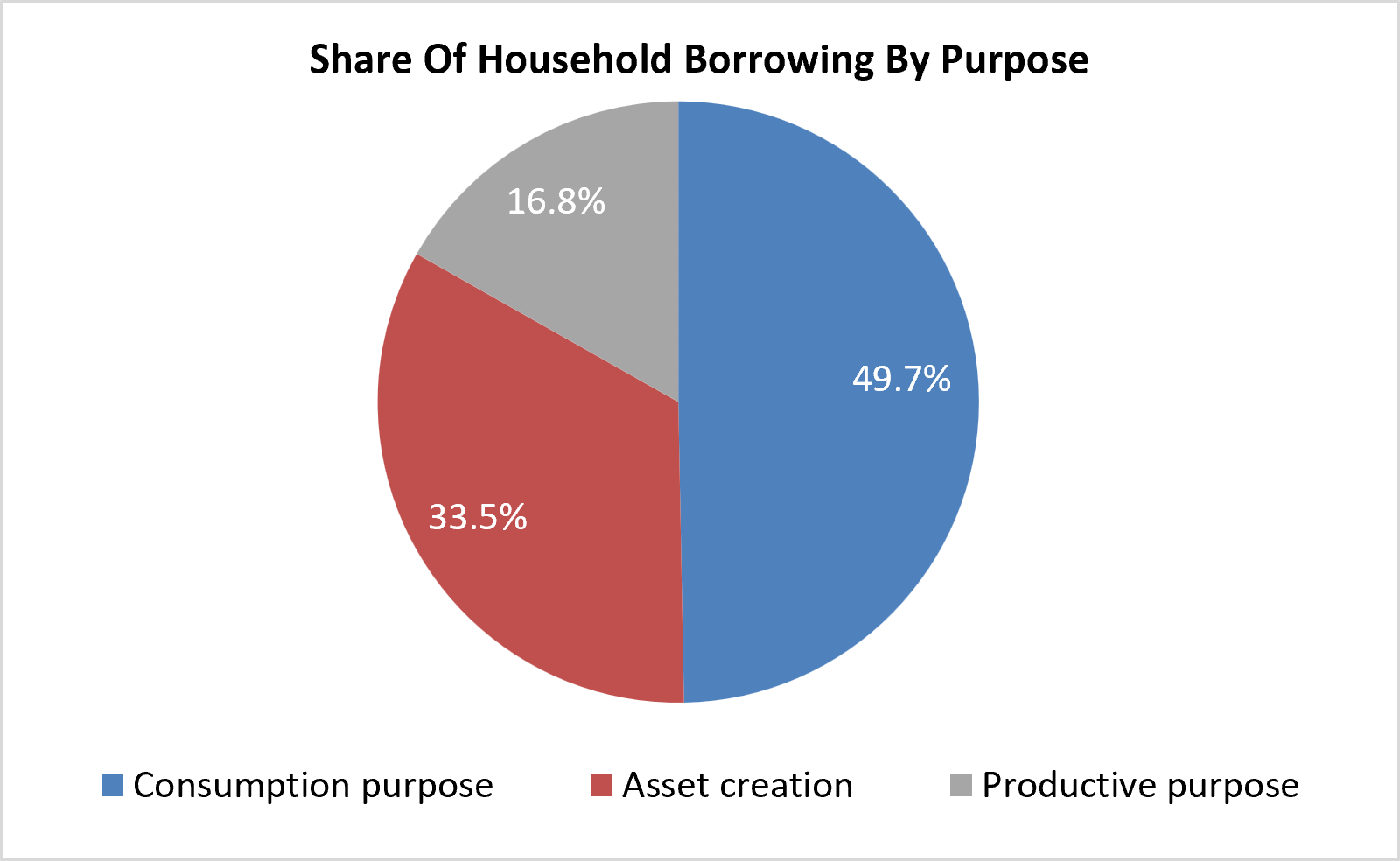
Source: RBI – Financial Stability report, June 26.
As can be seen above debt for consumption is 49.7%. This is worrisome. Some may argue that other 3 world countries have a higher Debt/GDP ratio like below:
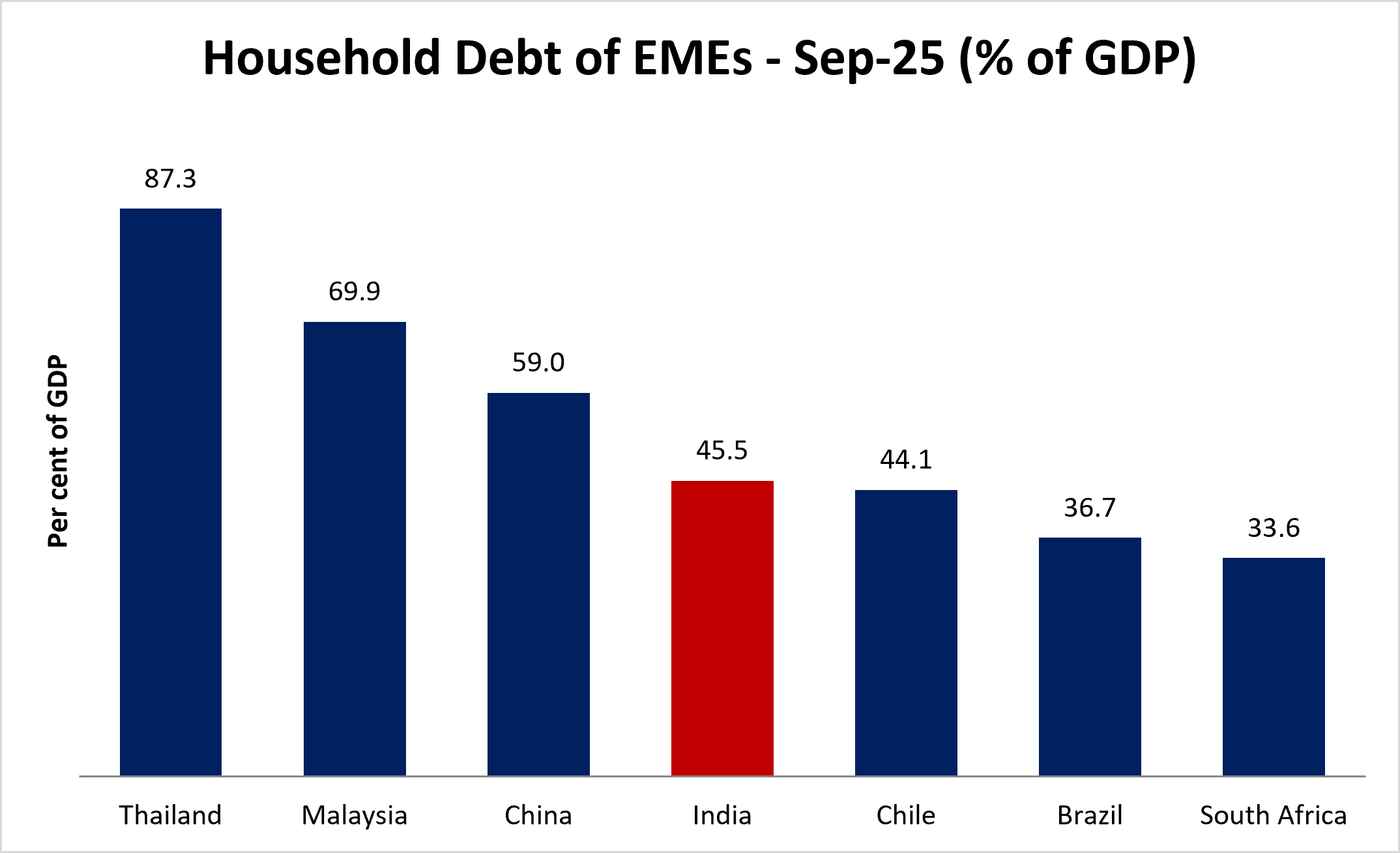
US can afford to have 122% Debt/GDP, but they have a currency which they can print and all countries accept. India's currency is not like that and any increase in Debt/GDP is worrisome. A false economic growth may be touted by the govt, but it is coming at a cost. The impact will be felt in future if our CAD and FC wealth of country does not improve through exports or otherwise.
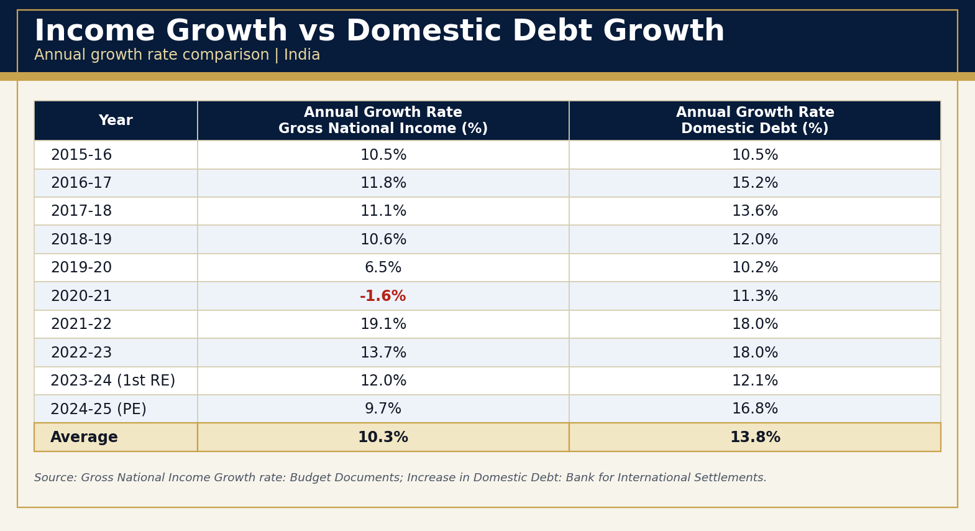
Another concerning thing is as Income growth reduces, Debt is increasing and looks older version of income savings and debt is being replaced by Debt Income with no savings.
As Kotak blog says.
Debt, in itself, is neither good nor bad. Its impact depends on what it finances and whether income growth keeps pace with repayment obligations. Borrowing that supports homeownership, education, entrepreneurship, and asset creation can strengthen long-term economic growth;
borrowing that outpaces income growth can eventually become a constraint.
Monday, August 3, 2026
COMPUTER AND MOBILE FRAUDS- PRECAUTIONS
As one hears about the reach of the financial independence to ordinary people through UPI/WAMD online transfer and as banks move from brick and mortar structure to online apps (not even websites now a days) and the incidents of AI doing many tasks, it is VERY IMPORTANT to ensure that you are not defrauded.
Please understand that to operate most of the apps, mobile phone number and emails are asked for and these could be a potential weak point in the fraud that takes place. While a mobile phone number and email per se could not cause fraud (as of now), but their usage to send a malware link or call forwarding could be a potential threat.
Some basics to perform or understand is essential. A few, not exhaustive, is given. You can suggest me more through my email @ mail.rsvp@gmail.com
a) Do not download unwanted apps
b) Do not pick up phones from unknown numbers
c) Install truecaller to identify the person calling
d) Do not click on unknown links
e) Do not fall for threats and do unnecessary actions.
f) If anyone is in danger and calls for money, always try to call them back or their relative to check the real situation (eg. a known caller might say that he is in thailand and needs you to send 1000$. Instead of sending, if you call him or his relative, you may be told that either he is at home or visiting a local place.
g) Do not hand over your phone to anybody. if someone wants to make a call from your phone, you input the number and let him talk with speaker on. Do not let the person walk a few meters to make the private call. Note: No one make a private call in emergency.
h) keep your apps and phones updated and install a good antivirus software (mckafee, eset etc.)
i) The largest method to avoid frauds is TIME. Most fraudsters catch you in your vulnerable time (parents/husband children in hospital and need money or they are caught in crime and need money to drop the case etc.). Listen to them and Buy time through one excuse or another. Check with other sources about the nature of event. Inform the Computer police (present in all countries) via another phone to trace the call if possible. Inform the potential fraudster that your friend or relative is in police and will get back to you on your number ASAP. Most of the time, the number is fraud or they will look for an easier target elsewhere and leave you.
j) Always, physically check with your boss or secretary if thru WA or call or video call, he/she asks for an urgent transfer. Buy time.
k) Do not join WA or any other group for more gains.
l) Do not fall for small gain given (like 200$ for joining, clicking a few likes etc) as easy money implies some evil intention.
m) Please understand that no one can give more than 12% return doing a decent business. Anyone says 50% etc. move away from them as there are enough people to fall prey.
n) Some do a prediction on probability. Eg. 50 people are split 25 and told it will rain (obviously during monsoon season). If it rains you now have 25 believers (skip the 25 who you told it will not rain but rained). Split again into 12 and 13. Say it will rain. If it rains, you have now 12 believers who has seen two chamatkars from you. Split the 12 into 6 and 6. Say, it will rain. If it rains you have 6 believers eating out of your hand (for them 3 times you predicted correctly)- you are the Nostradamus. Now these 6 become dead ducks for scam
m) Do not put your FD on autorenewal for ease or rate. Put it on -let it come to my account and then do a fresh FD. This ensures a) you do not forget you have FD b) prevents some bank insider pledging your funds to play in market or elsewhere.
n) While most of the people lock their phone using passcode, some may not and it gives one more avenue for people to use your phone. Always use passcode and remember them to unlock your phone. I will prefer not to use FACE ID as it may require you to be present when using the phone and you want someone close to you to use it
Sunday, August 2, 2026
RNOR- Working

| NRI | |||||||||||||||
| NA | RNOR | RNOR | RNOR | ||||||||||||
| NRI | RES | RES | RES | ||||||||||||
| Returns | |||||||||||||||
| For returning indians | |||||||||||||||
| For spl. Tax planning indians who can travel outside. | |||||||||||||||
RNOR- Understanding it.
Easy for people to understand NRI as it is a simple > 182 days outside India makes you one.
RNOR is the beast one needs to understand and I have tried to give a brief below.
a) Key to RNOR is finding it in each year. Its primarily you become a resident (182 days or more in India) and you are no longer an NRI.
b) You can generally have it for 2 years, but 3 years requires a bit of gymnastics as the stay in India for 729 days in the preceding 7 years kicks in.
c) The benefit is for income earned outside India and you can plan during those RNOR time to bring in your money without paying tax.
RNOR status is determined based on your residency in India over the past 10 years and the number of days spent in India in the preceding 7 years, with specific tests under the Income Tax Act.
Determining RNOR Status
RNOR is a transitional tax status for
returning NRIs, allowing foreign income to remain largely tax-free in India for
a limited period. To qualify, you must first be a resident in
India for the financial year, which generally requires spending 182
days or more in India during that year or meeting certain
employment-related conditions investmates.io+1.
Once you are a resident, RNOR status is determined if EITHER of the
following conditions is met:
- Non-resident in 9 out of the 10 preceding years: If you were a non-resident in at least 9 of the 10 previous financial years, you automatically qualify for RNOR status
- Spent less than 729 days in India in the preceding 7 years: This test counts the total number of days you were physically present in India over the 7 financial years before your return year. If the total is less than 729 days, you qualify for RNOR
Key Rules and Considerations
- Financial Year Counting: India counts the entire April–March financial year in which you return, even if you arrive mid-year
- Duration of RNOR: Typically, RNOR status lasts 2–3 financial years after your return, depending on your prior non-resident history
- Foreign Income Taxation: During RNOR, most foreign income, including interest, capital gains, and rental income from abroad, is not taxable in India taxaj.com.
- Day-Count Accuracy: Precise counting of days using passport stamps or travel records is essential, as even a single day can affect your status investmates.io
- Difference from ROR: Once RNOR
conditions are no longer met, you become Resident and Ordinarily
Resident (ROR), at which point worldwide income becomes taxable in
India
 investmates.io.
Practical Steps for Calculation
- Check residency for the current financial year using the 182-day rule or employment criteria.
- Review your last 10 years of residency to see if you were non-resident in 9 of them.
- Sum your days in India over the last 7 years to see if it is below 729 days.
- Determine RNOR duration based
on which condition applies and plan financial moves accordingly, such as
repatriating foreign funds or withdrawing from foreign retirement accounts
during the RNOR window
 desireturn.com+1.
By following these steps, you can accurately calculate your RNOR status and optimize tax planning for returning NRIs.
Here’s How to Check if You're RNOR
You can determine your RNOR status by answering two questions.
Question 1: Are you an Indian tax resident this financial year?
RNOR is a sub-category of resident. So before the RNOR question even arises, check whether you qualify as an Indian tax resident for the year under Section 6(1) of the Income-tax Act.
You are a resident if you were physically present in India for:
- 182 days or more during the financial year, or
- 60 days or more during the financial year and 365 days or more across the four preceding financial years.
The carve-out for NRIs and PIOs visiting India: the 60-day threshold generally doesn’t apply to Indian citizens and Persons of Indian Origin coming on a visit. Instead:
- If your total income (excluding income from foreign sources) is up to ₹15 lakh, the threshold is relaxed to 182 days.
- If it exceeds ₹15 lakh, the threshold is 120 days (provided you also spent 365+ days in India across the preceding 4 years). Becoming resident under this 120-day rule automatically makes you RNOR — not ROR.
Question 2: Do you pass either RNOR condition?
You qualify as RNOR if you meet either one of the following two conditions (not both). This is the single most misunderstood part of the rules.
Condition 1: The 9-out-of-10 test
You were a Non-Resident in at least 9 of the 10 financial years immediately preceding the current one. This is how most long-term NRIs qualify.
Example: Rohan moved to California in 2015 and returned in 2026. He was a Non-Resident in all ten preceding financial years, so he qualifies.
Condition 2: The 729-day test
Your total stay in India across the 7 preceding financial years is 729 days or less. This test counts only days - your residency labels for those years don’t matter.
Example: Amit lived in New York for eight years, visiting India about 70 days a year. His 7-year total is roughly 490 days - comfortably under 729. He qualifies.
Counter-example: Sneha left India in FY 2020–21 and returned in FY 2025–26. She fails Condition 1 (only about five Non-Resident years in the last ten) - and she fails Condition 2 as well, because she lived in India full-time for three of the last seven years, putting her far past 729 days. She becomes ROR as soon as she is a resident again.
Either condition is enough. If you fail the 9-out-of-10 test, you may still qualify through the 729-day test — and vice versa. Always check both before concluding you’re not RNOR.

Example: Calculating RNOR Status
Let's walk through a real scenario.
Amrita returned to India permanently in July 2026 after living and working in the US for 12 years. Here's how she would determine her residential status.
Step 1: Is Amrita an Indian tax resident?
From July to March 31, Amrita spends about 274 days in India in FY 2026-27. That's more than 182, so she is an Indian tax resident for the year. On to Step 2.
Step 2: Does Amrita qualify for RNOR?
She checks the two rules. She was a Non-Resident in all 10 preceding financial years, and her occasional visits add up to well under 729 days across the last 7. She only needed one of these; she has both. Amrita is RNOR for FY 2026-27.
What if Amrita had moved abroad in 2023 instead of 2014?
She would still become a tax resident on returning, but she'd fail both RNOR rules: only three Non-Resident years in the last ten, and since she lived in India until 2023, her 7-year day count is around 1,460 days, nearly double the limit. She would become a Resident and Ordinarily Resident (ROR) almost immediately.
How to calculate RNOR yourself
You need one thing: an accurate log of your days in India. After that, it's mechanical.
- Pull your travel history. Passport stamps, airline itineraries, or immigration records. Count both arrival and departure days as full days in India.
- Build a year-wise table. One row per financial year for the 10 FYs before your return: days in India, and whether that made you Resident (182+) or Non-Resident.
- Count your Non-Resident years in the last 10. Nine or more means Condition 1 is met.
- Total your days across the last 7 FYs. 729 or less means Condition 2 is met.
Statuses are recalculated every year on a rolling basis, so repeat this for each future year.
The key takeaway
Don't focus on how many years you've lived abroad. Instead, answer these three questions:
- Have you become an Indian tax resident?
- Were you a Non-Resident for 9 of the last 10 financial years?
- Did you spend 729 days or less in India during the previous 7 financial years?
Your answers will usually tell you whether you're NR, RNOR, or ROR.
How Long Does RNOR Last? (Usually 2 years. 3 at most!)
This is one of the most common questions returning NRIs have, and the answer often surprises them.
There isn't a fixed RNOR period. Unlike a visa that's valid for a set number of years, your RNOR status is determined separately for every financial year. You don't automatically get RNOR for two or three years after returning to India; your eligibility is recalculated every year using the same rules discussed above.
Here's why two years is the ceiling for most people. Each year, the 9-out-of-10 test looks at the 10 years behind it. In your first two years back, your NRI years still fill that window. By year three, your own post-return resident years have crowded them out, and the test fails. The 729-day test rarely rescues you either, because your first full years back in India add 300+ days each to the count.
What this means for different situations:
|
Your situation |
Likely outcome |
|
You lived abroad for 10+ years and visited India only occasionally |
Typically two RNOR years after returning |
|
You frequently visited India while living abroad |
Your RNOR period may be shorter, because you've already accumulated more days in India |
|
You lived abroad for only a few years before returning permanently |
You may not qualify for RNOR at all and could become ROR soon after becoming a tax resident |
Planning tip: Estimate your RNOR window before relocating. It shapes when to sell foreign investments, take retirement distributions, and restructure assets. More on this below.
Why your return date matters more than you think
Whether the year of return itself becomes your first RNOR year depends on when you land:
|
You return in… |
Year of return |
Your RNOR years |
|
April–June |
Resident (182+ days). RNOR year 1 used up immediately |
Return year + 1 more |
|
July–September |
Usually Resident |
Return year + 1 more |
|
October onwards (under 182 days left in the FY) |
Stays NRI |
The two following FYs |
Returning in the second half of the financial year shifts your whole RNOR window one year later: you stay NRI for the year of return (foreign income untaxed) and then get two full RNOR years. If your move date is flexible, landing after early October is usually the better deal. In Amrita's case above, waiting from July to October would have bought her an extra NRI year before her RNOR clock started.
Can you stretch it to 3 years?
Only through the 729-day test, and only with deliberate planning: short pre-return visits, plus 2 to 3 months outside India each year even after returning, so your rolling 7-year day count stays under 729 into a third year. For most people this isn't practical. Plan around 2 years.
What's taxable during your RNOR years?
The short version: your Indian income is taxable; your foreign income generally is not, unless it comes from a business or profession controlled from India. In detail (per Section 5 of the Income-tax Act):
|
Nature of income |
RNOR treatment |
Examples & notes |
|
Received (or deemed received) in India |
Taxable |
NRO account interest; any income credited directly to an Indian bank account. Remitting money you already received abroad is not "receipt in India". |
|
Accruing or arising in India |
Taxable |
Salary for work done in India (even if paid into a foreign account); rent from Indian property; capital gains on Indian stocks, mutual funds, or real estate. |
|
Foreign income from a business controlled / profession set up in India |
Taxable |
You run a Dubai consulting firm but take the management decisions from India. That income is taxable. |
|
All other foreign income |
Not taxable |
Foreign salary and rent; interest from foreign banks; overseas capital gains and dividends; 401(k), IRA, or UK pension distributions received abroad. |
What should you actually do during your RNOR window?
The RNOR years are a planning window, not just a tax break. Before ROR arrives:
- Review overseas investments. Gains realized while RNOR generally escape Indian tax; the same gains realized after becoming ROR won't.
- Decide on foreign retirement accounts. Understand how your 401(k)/IRA distributions will be taxed once you're ROR, and whether to withdraw or restructure earlier.
- Prepare for Schedule FA. From your first ROR year, every foreign asset (bank accounts, brokerage accounts, stock options, property) must be disclosed in your Indian return. Start the inventory now.
- Map your DTAA relief. Where income will be taxed in both countries, know which treaty credits you can claim.
- Talk to a cross-border CA before your final RNOR year ends, not after.
When RNOR ends
The transition to ROR changes your tax life materially. India begins taxing your worldwide income, including US dividends, brokerage gains, and retirement distributions, with DTAA credits available for foreign taxes paid. Schedule FA disclosure of all foreign assets becomes mandatory, with severe penalties under the Black Money Act for omissions.
Common mistakes returning NRIs make
- Using calendar years instead of financial years. Everything runs April 1 to March 31.
- Confusing FEMA residency with tax residency. FEMA governs your bank accounts (NRE/NRO conversion); the Income-tax Act governs your taxes. The definitions differ: FEMA status can change the day you return, while tax status waits for day counts.
- Ignoring arrival and departure days. Both count as full days in India.
- Assuming both RNOR conditions must be met. Either one is enough.
- Waiting until ROR to plan. The window to restructure foreign assets tax-efficiently is the RNOR period itself.
FAQs
Do I need to apply for RNOR status?
No. It's determined automatically from your travel history each year; there's
no form or approval. You simply declare the correct status in your tax return.
How long does RNOR usually last?
Two financial years for most returning NRIs. A third year is possible only via
the 729-day test, with careful planning of your India days.
Can I lose RNOR status earlier than
expected?
Yes, if you spent more days in India during the lookback years than you
assumed. Recount from passport stamps before relying on it.
If my flight lands at 11:30 PM, does
that day count toward my stay?
Yes. Arrival and departure days both count as full days of physical presence.
Can my spouse keep RNOR status after I
become a full resident?
Yes. Residency is tested individually; each person's own travel history
decides.
What happens to my US 401(k) withdrawals
after RNOR ends?
Once you're ROR, distributions become taxable in India, with DTAA credit for US
tax already paid.
Does RNOR mean I don't need to file an
Indian tax return?
No. If your Indian-sourced income exceeds the basic exemption limit, you must
file. RNOR changes what's taxed, not whether you file.
Disclaimer: Tax laws and residency definitions are subject to change. This guide is for informational purposes only and does not constitute tax or legal advice. Verify your travel logs and financial structures with a qualified chartered accountant before filing.
Demat. Digital notarization. Document courier. Money transfers. All done from the comfort of your couch. RUPEEFLO
Friday, July 31, 2026
Smith manouvre - Canada housing
In canada, the interest on housing loan (for self) is not tax deductible.
Smith, tried an alternative for getting better returns. This is how it works. Apart from getting tax benefit, there is a risky excess return.
I have adapted the below article to suit the reader.
Smith Maneuver Explained: Make Your Canadian Mortgage Interest Tax Deductible
By
Definition
The Smith Maneuver is a Canadian financial strategy that enables homeowners to convert mortgage interest on an investment loan into tax-deductible interest and potentially increasing wealth over time.
Key Takeaways
- The Smith Maneuver is a financial strategy designed in Canada to make mortgage interest tax-deductible by converting it into investment loan interest, potentially leading to significant tax savings and faster mortgage repayment.
- To implement the Smith Maneuver, homeowners must have a re advanceable mortgage that combines a traditional mortgage and a home equity line of credit (HELOC).
- The strategy involves using the HELOC to reinvest the principal portion of monthly mortgage repayments into income-generating investments, thus creating opportunities for compound growth and enhanced tax deductions.
- Several accelerators, such as the Debt Swap and Cash Flow Dam, can be used to enhance the benefits of the Smith Maneuver, potentially increasing the speed of debt conversion and tax deduction accumulation.
- Despite its advantages, the Smith Maneuver carries risks, including interest rate fluctuations and market volatility, and requires careful consideration and consultation with financial professionals to avoid potential downsides.
What Is the Smith Maneuver?
The Smith Maneuver is a legal Canadian tax strategy developed by financial planner Fraser Smith that converts mortgage interest into tax-deductible investment loan interest. It typically requires a readvanceable mortgage to work effectively.
Fraser Smith, a financial planner based in Vancouver Island, Canada, developed the Smith Maneuver in the 1980s and popularized it in a book by the same name, published in 2002.
Smith refers to this maneuver as a debt conversion strategy, rather than a leveraging tactic, on the basis that it does not involve acquiring any incremental debt and can potentially lead to tax refunds, faster mortgage repayment, and a larger retirement portfolio.2
In Canada, even though interest on a mortgage is not tax deductible, the interest paid on loans for investments is tax deductible. (It’s important to note that this does not extend to loans taken for investments made in registered plans, such as Registered Retirement Savings Plans (RRSPs), and other tax-free accounts, because they are already tax-advantaged.)
For the Smith Maneuver, a borrower needs to obtain a readvanceable mortgage, which is slightly different from a conventional mortgage.1 A readvanceable mortgage consists of a mortgage and a line of credit called a HELOC (a home equity line of credit) bundled together. A HELOC allows you to borrow up to a certain percentage of the value of your home.
Consumer Financial Protection Bureau. “What You Should Know About Home Equity Lines of Credit (HELOC).”
Once this is accomplished, the homeowner can transform mortgage loan interest into tax-deductible investment loan interest.
In Canada, borrowing to purchase a primary residence is not considered tax-deductible borrowing because there is no reasonable expectation of generating income from the home in which one lives.
Each month, borrowers repay their mortgage principal and simultaneously re-borrow that amount using the line of credit to invest in qualifying investments.
- The net debt for this borrower remains the same because, for every dollar of the mortgage principal that is repaid to the lender, another dollar is borrowed under the line of credit.
- The line of credit funds are invested at a higher return rate than the interest rate on the credit. The interest payments on the line of credit in this situation are tax deductible.
- Therefore, if the stated borrowing rate is 6%, and if the taxpayer is at the 40% marginal tax rate, the real rate of interest is only 3.6% (interest rate*[1-MTR]). If the strategy is executed properly, it should theoretically result in a tax refund when the borrower files their income taxes in Canada.
- Finally, the borrower can use their tax refund to pay down their mortgage, and then access the resultant available credit to invest.
Self-employed Canadians, not taxed at source, can calculate the tax relief provided by the strategy.
Apart from the contributions to the investment portfolio that are increasing the amount invested on a monthly basis, and the investment from the application of the tax relief, the amortization of the non-deductible mortgage is reduced due to the annual mortgage prepayments.
Bear in mind that this means additional leverage. Your total debt will increase above and beyond the original mortgage debt and should be carefully considered in consultation with financial professionals.
Key Risks and Costs of a HELOC
- Variable rates: Interest rates can go up, making payments higher.
- House as risk: Your home is collateral, so you can lose it if you do not pay.
- Extra fees: Closing costs, annual fees, or transaction minimums may apply.
Subscribe to:
Posts (Atom)